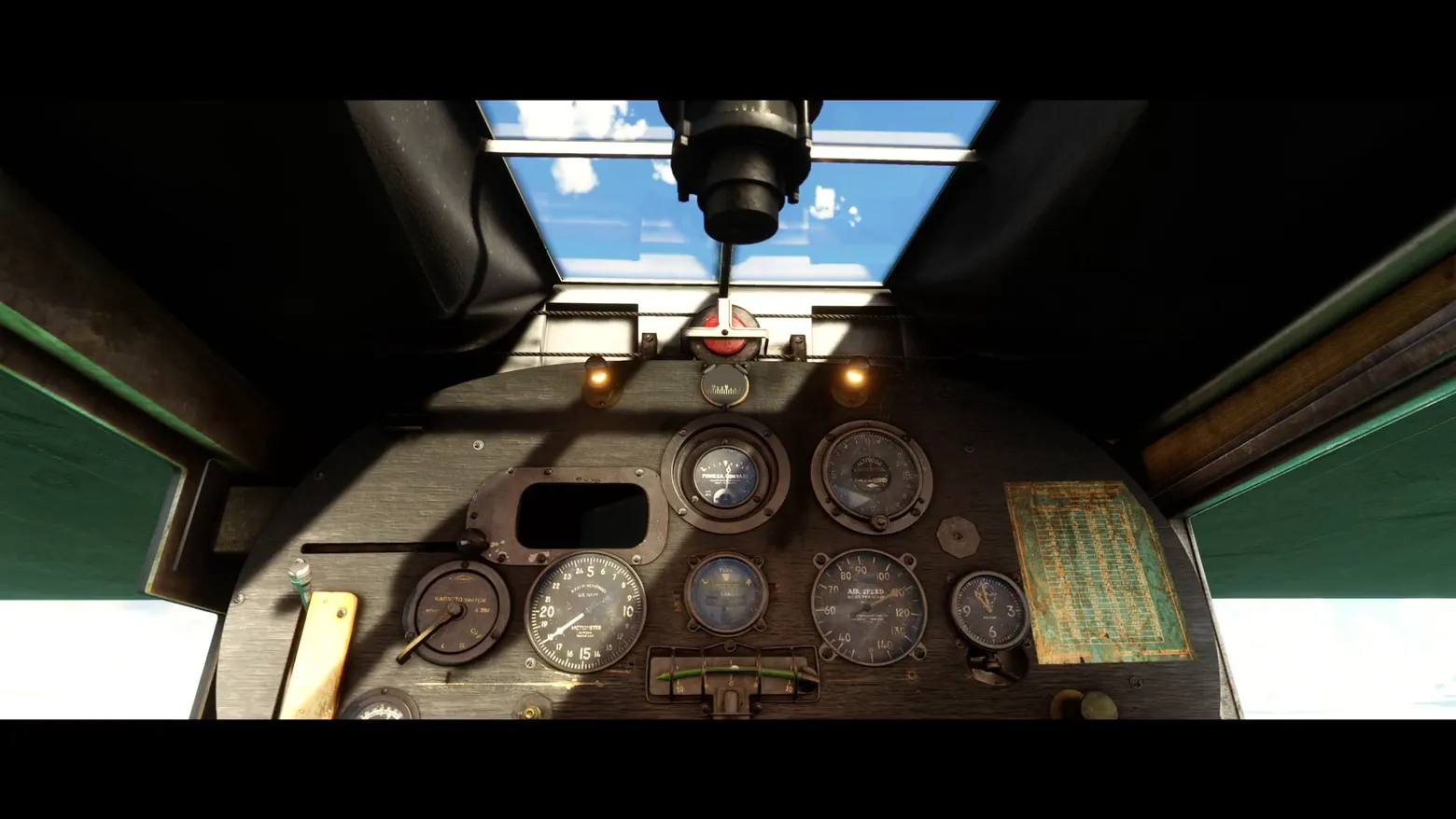
Spirit of St. Louis cockpit: the steam-gauge panel, straight-on
Microsoft Flight Simulator · HUD & Gameplay UI
Art style Realistic 3D
About this game
Developer: Asobo Studio · Publisher: Xbox Game Studios · Platform: PC (Steam) · Art style: Realistic 3D · Screen type: HUD & Gameplay UI
More Microsoft Flight Simulator screens in the Gallery
What to study
Before the glass cockpit, the interface was the aeroplane itself. The Spirit of St. Louis panel, the 40th Anniversary trailer cuts inside it for about two seconds, between exterior shots of the same aircraft, gives the pilot exactly one dial per fact and nothing else: airspeed on a dial whose whole scale runs 40 to 140, engine speed on the large gauge beside it, compass and altimeter above, a magneto switch you turn by its handle, and a green inclinometer tube at the panel's base for keeping the ball centred. There is no screen, no menu and no prompt; state is read off needle positions at a glance, which is why the dials are big, round and high-contrast. Even the checklist is physical, a printed placard screwed to the panel's right side, its rows worn green with age, consulted by looking right rather than opening a window. The empty rectangular cut-out left of centre, where a dial is simply missing, is part of the lesson: this interface degrades by absence, not by error message. Filed against a game famous for its G1000 glass cockpits and world-map planning screens, this is the baseline those designs replaced, and the trailer, which shows no menu layer at all, preserves only this end of the spectrum. Frame at about 1:15 in the '40th Anniversary' video (Steam), extracted by the pipeline's scene-change pass at 74.9s; timed probes at 75-76s show the camera pulling back, so this is the closest framing in the segment.
Patterns
How the screen is arranged.
Components
Parts on screen.
Screen inventory
- arched dark-wood instrument panel filling the lower half of the frame, seen straight-on from the pilot's seat
- AIR SPEED dial at lower centre-right, its face reading AIR SPEED with scale marks from 40 to 140
- large round engine gauge at lower centre-left with numerals running past 20 and its needle swung up-scale
- round compass dial centred at the top of the panel, with a smaller altimeter-style dial at the panel's top right
- MAGNETO SWITCH dial at lower left with its pointer handle swung to one side
- small blue-faced dial at the panel's centre, between the two large gauges
- green inclinometer tube at the panel's bottom centre, its scale marked 10-0-10
- weathered green checklist placard screwed to the panel's right side, its printed entries arranged as a table
- empty rectangular instrument cut-out left of centre, its dial missing
- two small amber panel lamps lit above the panel, flanking a small central gauge
- overhead skylight above the panel showing blue sky and cloud, with a black cylindrical instrument housing hanging in front of it
Top 3 colors
#000000 23%#2f291e 23%#010101 18%
Top three palette colors by share. The remaining colors make up the rest.
Source and credit
© Asobo Studio / Xbox Game Studios, Microsoft Flight Simulator screenshot: Microsoft Flight Simulator '40th Anniversary' video (Steam), shown for design study and commentary. PlayCraft is an unofficial fan project, not affiliated with or endorsed by Xbox Game Studios.
Source tier 2 (publisher-released) · screenshot: Steam store page · Steam page
Source details
Fetched 2026-10-21. verified 2026-10-21: candidate frame v0_0029.png extracted by the pipeline at 74.9s from the '40th Anniversary' video (Steam) and inspected visually at full resolution (1920x1080 native); genuine in-game Spirit of St. Louis cockpit confirmed settled and legible (AIR SPEED dial and its 40-140 scale, the large engine gauge, compass and altimeter dials, MAGNETO SWITCH label, green inclinometer and the printed checklist placard all readable as listed); the aircraft is identified from the same segment's exterior frames at 74.0-74.5s showing 'Spirit of St. Louis' nose lettering; no trailer text or watermark overlays the frame apart from the source video's letterbox bars
no published policy found (checked 2026-10-21); fair-use study use, takedown honored within 48h
Rights holders: see Copyright & takedown.
Similar screens
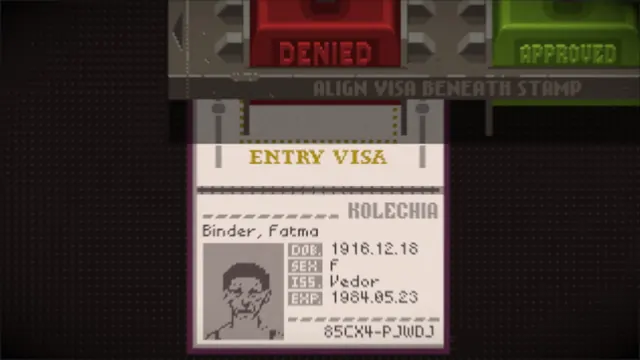 Papers, Please - Stamping the verdict: Kolechia entry visa beneath the stamps
Same type: HUD & Gameplay UI; Shared patterns: diegetic-controls
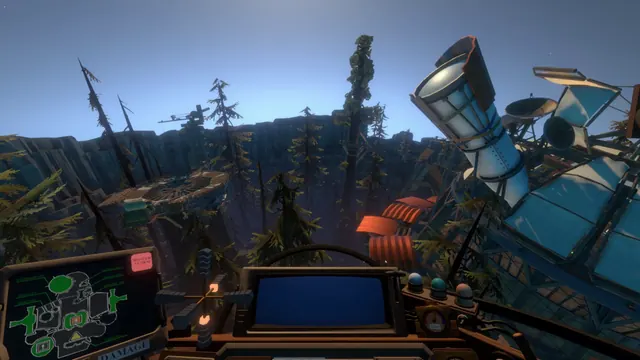 Outer Wilds - Ship cockpit: the DAMAGE schematic dashboard
Same type: HUD & Gameplay UI; Shared patterns: diegetic-controls
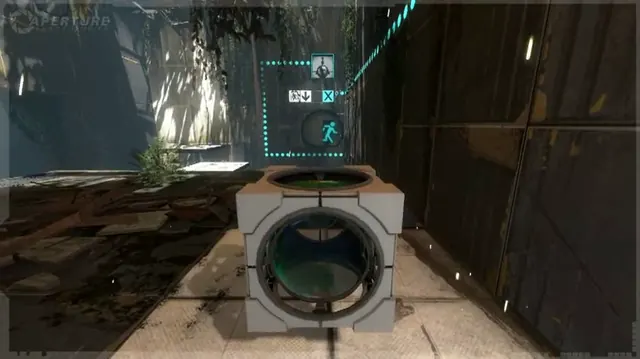 Portal 2 - Pneumatic vent and exit signage: the chamber reads itself
Same type: HUD & Gameplay UI; Shared patterns: diegetic-controls
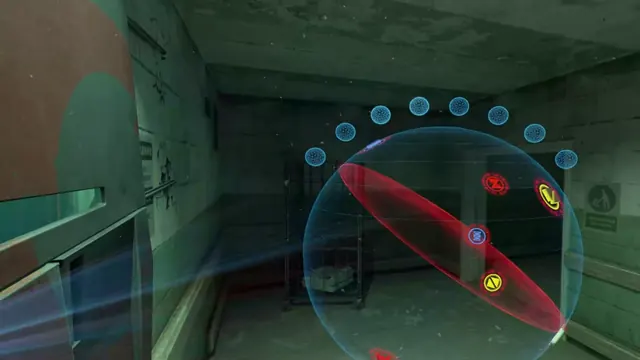 Half-Life: Alyx - Multi-tool hacking: the sphere puzzle, whole
Same type: HUD & Gameplay UI; Shared patterns: diegetic-controls
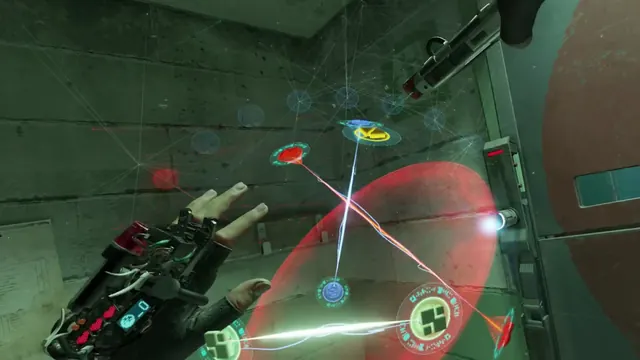 Half-Life: Alyx - Hacking in progress: glove display and connected nodes
Same type: HUD & Gameplay UI; Shared patterns: diegetic-controls
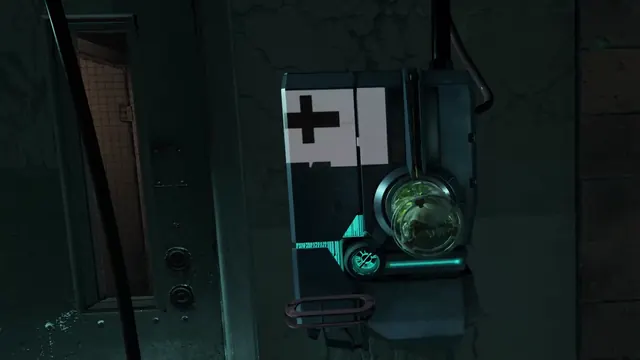 Half-Life: Alyx - Combine health station: the cross panel and the grub canister
Same type: HUD & Gameplay UI; Shared patterns: diegetic-controls